
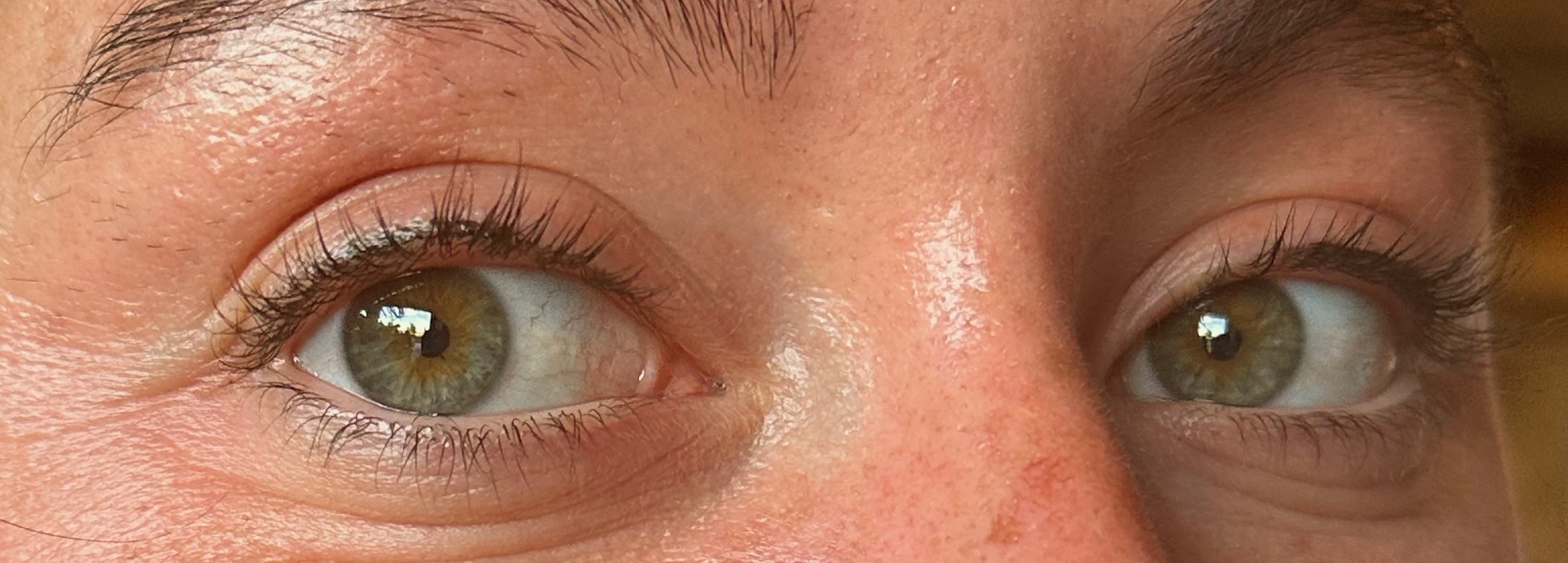
“That’s just how you’re made.”
I was essentially doing nothing when it started – a flash of light in my right eye. Then another. Then a field of floaters — small round circles I couldn’t stop staring at, even though staring at floaters is its own strange joke. A retinal tear is the kind of phrase that gets you seen the same day.
“That’s your red blood cells,” the doctor said. Yikes, but also — kind of cool. The one time in my life I’ve “seen” blood outside of where it belongs, and it didn’t even hurt. From the outside, nothing about me looked different. Inside, it was a different story entirely.
Did you fall? Get hit? No. I hadn’t tripped, fallen, been hit, or even sneezed hard.
So what caused it? “It’s part of aging.” I was 56. My mother and her friends, all in their 70s and 80s, don’t have this. No one in my family does. No one I know does. Maybe I just needed to meet more people — broaden my circle to include the ophthalmology crowd.
“That’s just how you’re made.” It reminded me of what I have noticed in so many people lately- not sick, but not necessarily well.
And so began nine months inside the subculture of vision repair — a world I never asked to join, but one that, once you’re in it, teaches you fast.
The surgeries stacked up.
First repair, and I figured I was done — cataracts were a future problem, years off. Six months later, the same flashing lights showed up in the other eye- again, routine life activities. No history of extreme nearsightedness, no high altitude ballistic activity, no previous eye surgery to trigger this (other than the one I had in the other eye). Same phrase: it’s just how you are made. Sticky vitreous material that pulls the vessels with it as it shrinks. Right. At least this time I knew the drill.
After the second repair, disappointment set in as there wasn’t the same clearing of vision as was expected. I mentioned it was like seeing everything through a dirty fish bowl. “Yeah, sometimes cataracts happen after this kind of surgery.” That’s what this was? A sudden massive post op cataract? What I also didn’t expect was my other eye deteriorating just as fast — glasses at night, then glasses always, then leaning into grocery shelves to read labels, inches from the TV to see the score of the game, unable to see my own face clearly in the mirror.
Cataract surgery came much earlier than I’d planned for. And with it, a bonus: in the freshly repaired eye, straight lines stopped being straight. Walls, door frames, floor tiles — all warped, like a fun-house mirror. Back in quickly for follow up.
“That’s an ERM,” they told me. An epiretinal membrane. Scar tissue on the retina. Fixable — but not until the cataracts were out. All very matter-of-fact in the opthalmology world. Much more than I wanted to learn or experience in my world, however. The lesson: this is what everyone experiences when they or a family member sustain an unforseen illness or injury. It is a detour we hope to avoid or something that happens to others.
And…This is why we Google.
A handout explaining the mechanics wasn’t enough. Nobody in clinic has time to sit with you — to acknowledge the what-ifs, the how-do-I-live-with-this in the meantime. Research is up to you, cautiously to ensure resources are true, not to go down rabbit holes of trauma and drama.
The hardest hit occurred after the first cataract came out. I could see more clearly, yes, and genuinely grateful. The fish bowl was cleaner now, more like a house of mirrors than a swamp. But I’d walked in expecting the next fix. Complete resolution. I assumed it would just get better. Nobody really told be otherwise, until the follow-up did.
The scar tissue needed more time, I was told after the third surgery check up. “But I really can’t see well,” I said, coaching myself not to cry in the office. Breathe. 4-7-8. Breathe. “Yeah, sorry,” was the answer. “Let’s see you back in three months. Your brain will adapt.”
Next. It was the conveyor belt. I was on it. “Any questions?” is often rhetorical. Clinics are full. The physicians are sharp and genuinely good at what they do — I respect them completely — but they don’t have the bandwidth for the questions you actually came in with. In the parking lot, I cried for fifteen minutes. This made it even harder to see, ironically, but I needed it. I cried from exhaustion — the exhaustion of a brain working overtime to interpret what it was seeing, of moving through a life that used to run on autopilot, of fearing this might be as good as it gets. I cried because I wasn’t ready for this next level of life yet.
Then I remembered Hal Elrod’s line: “Can’t change it.” I believe in responding instead of reacting (still working on that) and in the actual neuroscience of neuroplasticity. This was the test for me to put it into action. I reminded myself: this is happening for me, not to me, and in the grand scheme, it’s still very minor. I now have even more empathy for anyone navigating an unexpected turn — which, eventually, is everyone. No one to blame here. Nothing “unfair” about it. I reminded myself of past events in my life, or in that of my family, where it seemed all would be lost. At the time, the thought was nothing good or redeeming could come from those events. In review, however, amazing opportunities, adventures, and new paths came from those detours-paths we would have never chosen or even thought to seek out- without being “forced” in a new direction. So after a good cry, I chose to re-assess.
NEXT. WHAT I ACTUALLY WANTED.
Like everyone else, I wanted reassurance. Connection. Someone to say this will be okay, and here’s what to do while you wait. Not because the doctors were failing at their job — they were doing exactly their job, from whatever capacity they had left in an appointment slot added onto an already-overrunning morning. I was the last add-on of a morning that had bled into the afternoon. I wanted more than “Yeah, I’m sorry.” I’d aimed that want at the wrong place. We need each other — but we also need to recognize what we need (name it), and where to actually find it. Left unexamined, that need curdles into anger, grief, resentment. The Book of Sirach states, “Can anyone nourish anger and expect healing?” Much of medicine is transactional, not relational. While that is frustrating, trying to squeeze orange juice from an apple was never going to work, no matter how hard I squeezed. So I turned to what I could do to heal. Only I know my own story — and having people to reflect it back to, to think out loud with, is the role wellness and community play. I had to recognize that the problem I had was reality- of things not going as I has wanted or expected. Reality keeps going at times without our permission. Stop arguing with it- you will lose every time.
Healing is a process. It was never meant to be transactional. Taking time to pause, reassess, recognize the facts and my response was key. It reminded me that this is exactly why and how I wanted change and to offer support in my own practice. Real experiences, real listening, real time equals optimal opportunities for healing. It also requires surrender. Surrender does not mean giving up. As Fr. Mike Schmitz states, surrender means giving access. It is a vulnerable state for sure, but it really is the quickest path to healing.
NEXT, RECONSIDERED:
Maybe “next” doesn’t have to mean the conveyor belt. Maybe it means the next vision — the one we usually only recognize in hindsight. Healing faster means stopping after the cry, naming what we are actually looking for, and pivoting toward it. Surrender to stop resisting what is true. It means broadening our circle before we need it, so when we pivot, the right people are already there. Unforeseen events will keep happening. The trick isn’t to brace for them in advance (that is fear and anxiety which definitely block healing) — it’s to recognize them when they land, laugh a little if you can (oh, we’re doing this now), pray, and find the gratitude anyway. Handle the objective stuff, and ask for help to do so. Show up for the relational stuff. The alternative — blame, anxiety, distraction — doesn’t protect us from anything, and does not change reality. It just blocks the healing.
From the outside, I look the same, or maybe a little tired. That’s most people, most days — carrying something invisible while looking perfectly normal. Look around (it’s good vision therapy anyway). However good or bad your own vision is, there’s an opportunity in front of you today to reach someone who’s just doing their own quiet repair work. Even a simple smile and real eye contact can show that you “see” them.
If you are seeking more relational health and wellness, along with more investigation as to why you may not be well or thriving, I am here for that. Contact me. Do not settle for “not really ill, but not really well.” We are called in faith to live our lives abundantly, in community, and in gratitude regardless of the reality of the day.
In Gratitude,
Jill Castro, MD
Schedule your consultation and experience the difference of truly personalized care.

304 Inverness Way S. Suite 100
Englewood, CO 80112
Get heath and wellness tips right in your inbox!
Optimal health is not just a goal, it's a way of life.”
304 Inverness Way S. Suite 100
Englewood, CO 80112